Central banks cannot claim much credibility when they keep falling short of their mandates
Copy link
twitter
facebook
whatsapp
email
Copy link
twitter
facebook
whatsapp
email
Copy link
twitter
facebook
whatsapp
email
Copy link
twitter
facebook
whatsapp
email
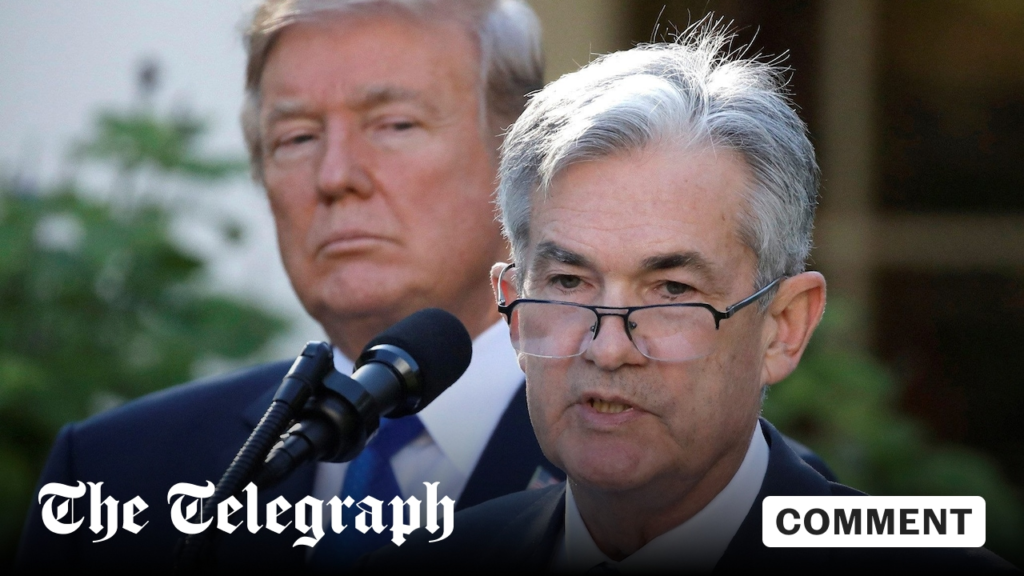
Knucklehead or numbskull? Donald Trump uses both terms to describe Jerome Powell, the chairman of the US Federal Reserve. It depends on which day of the week it is.
His attacks on Powell are now so frequent they have lost the power to shock, but imagine the horror if Sir Keir Starmer started regularly describing Andrew Bailey, the Governor of the Bank of England, as a nitwit or a simpleton.
Or if France’s president, Emmanuel Macron, were to refer to Christine Lagarde, the president of the European Central Bank, as a “nigaud” or “crétin”.
Imagine also if they let it be known that they were examining ways of ridding themselves of their troublesome monetary priests, as Trump has done in the US.
The entire political and economic establishment would be up in arms and there would be mayhem in the bond markets. Yet Trump is Trump and iconoclasm comes with the territory.
Trump’s bark may in practice turn out to be worse than his bite. It often does. It is none the less worth considering whether in this instance he might not have a point.
Looked at objectively, the unwritten understanding that presiding governments should never criticise their central banks is one of the modern world’s more absurd conventions.
Of course, we all know how it came about. It was part of a much wider shift in which key parts of government were removed from direct political control and vested instead with independent technocrats.
Free from the need to win elections, it was argued, these arms-length bodies would do a much better job than the politicians in keeping things on the straight and narrow.
In Britain, granting the Bank of England independent control of monetary policy, was very much part of the then-Labour government’s attempt to sanitise itself with markets and present the UK as a trusted and stable monetary regime that had finally put its post-war inflationary past behind it.
As with most other central banks, independence has been buttressed by provisions that make it virtually impossible to sack the incumbent governor except in the case of madness or misfeasance.
Much as he would like to dismiss Powell, even Trump has struggled to find a way around these guardrails. The ballooning costs of renovating the Federal Reserve’s grandiose Washington headquarters may be evidence of public sector waste and incompetence but it is not, on the face of it, a case of outright fraud.
All the same, the lavish nature of the Fed’s refurbishment touches a chord that characterises central banks as out of control, unaccountable and often just plain wrong. And now they build themselves palaces and cathedrals as symbols of the once-ruling idolatry.
Admittedly, Trump’s own vulgar redecoration of the Oval Office in his trademark gold chintz is in some respects just as bad, even if far less expensive.
But at least Trump is elected, while Powell is a mere appointee.
This in itself is causing much amusement, for in this week describing Powell as a “terrible” chairman, Trump added that he was “surprised he was appointed”, seeming to forget that it was he who originally chose him.
He soon regretted it and, by the end of Trump’s first presidency, the two were barely on speaking terms.
The stand-off has continued into Trump’s second term in an almost exact replica of Richard Nixon’s relationship with his own serving Federal Reserve chairman, Arthur Burns.
Burns was relentlessly bullied, briefed against and cajoled into going along with Nixon’s demands for easier money and thereby played a significant role in the subsequent inflation.
Powell seems to be made of sterner stuff and, no doubt with Burns in mind, is determined to resist Trump as long as he can.
But who’s to say he’s right and Trump is wrong? It’s not as if the judgment of central bankers has exactly been sound in recent years.
Collectively, they completely missed the surge in inflation that followed the pandemic and Putin’s murderous invasion of Ukraine.
They failed to see it coming and, even when it was obvious to all, they were far too quick to dismiss it as “transitory” – a one-off shock that would soon blow over.
Price stability 101; spikes in inflation nearly always result in second-round effects, with wages chasing prices higher. But from the US Fed to the Bank of England and the European Central Bank, they all seemed to forget their “Phillips curve” economics.
Nearly two decades of on/off money printing has, moreover, left Western economies in a state of dilapidated decay, with governments struggling under mountainous debt, widening wealth inequalities and stagnant living standards.
It’s not entirely the fault of central banks. For much of the 15 years that have elapsed since the financial crisis, they were the only game in town.
The political class was only too happy to lean on the support of ultra-low interest rates and repeated rounds of quantitative easing.
In practice, these have turned out to be no more than sticking-plaster solutions to much deeper structural faults that the politicians are scared of addressing. The politicians abdicated their responsibilities and left it to their central banks to paper over the cracks.
Even so, the whole point of central bank independence is that it is meant to lend credibility to monetary policy and prevent governments from manipulating it to their own ends.
How’s that worked out? Not so well. The UK inflation rate has been above its target level of 2pc for more than four years now, sometimes substantially so, and the US inflation rate for more than three years. What credibility can central banks have when they have fallen so far short of their mandates?
Bond market vigilantes provide at least a modicum of defence; every time Trump threatens to sack Powell, market interest rates spike, forcing Trump to back off. But the veil slipped a long time ago and these latter-day deities no longer command the authority they once did.
All economic orthodoxies have their time on the stage but then fall short and lose their potency. Unfortunately for them, central banks find themselves strongly associated with the failure of centrist government more widely. All of a sudden, they are seen as part of the problem rather than the solution.
Trump’s insistence on much lower interest rates doesn’t make a lot of sense at a time when his tariff policies are adding to inflationary pressures.
Nor would the appointment of a yes-man as chairman of the Federal Reserve obviously help with perceptions, still less giving the job to Scott Bessent so that he could combine it with that of treasury secretary. I’m pretty sure Bessent himself would baulk at that, minded though Trump might be to do it.
But Trump is perfectly entitled to criticise and, in the interests of debate alone, it is a good thing that he does. The emperor lost his clothes a long time ago; someone has to say it.
Copy link
twitter
facebook
whatsapp
email